
International Commercial Terms, known as Incoterms, are a set of standard terms used throughout the logistics industry. They define the responsibilities, risks, and costs of buyers and sellers at each step of the freight forwarding process. Know your Incoterms, know the process!
Incoterms consist of a three-letter abbreviation, such as FOB (Free on Board), CIF (Cost, Insurance, and Freight), and DAP (Delivered at Place), among others. The current official set of Incoterms were set by the International Chamber of Commerce on January 1, 2020. They consist of 11 terms, four of which are designated specifically for ocean freight only. The remaining seven terms can be applied to any type of transport mode – Road, Air, Rail and Sea.
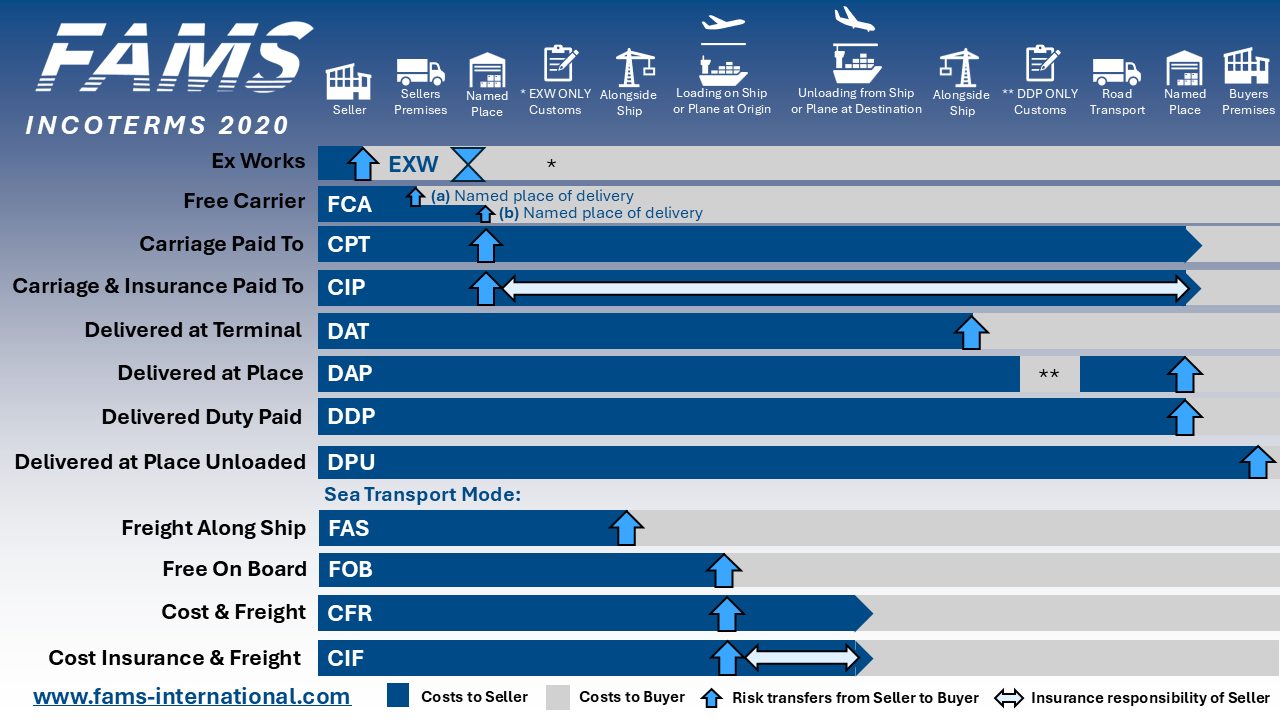
Can be used for any mode of transport – Road, Air, Rail and Sea.
Goods are made ready for pickup at Seller’s premises (such as a factory, warehouse, or another location). From that point onward, the Buyer is responsible for all costs and risks associated with the transportation of the goods to their final destination, including export and import customs clearance. This term is often used when the Buyer can manage transportation costs more effectively than the seller.
Seller is responsible for delivering the packaged goods to a carrier or nominated party at an agreed location (be it the Sellers’ premises or another named place). Seller handles export customs clearance. Costs and risks become the Buyer’s responsibility from that point forward, including import customs clearance. This term is often used when the Buyer can manage transportation costs better than the Seller but wants the Seller to handle export customs clearance and loading the goods at pick up.
Seller is responsible for arranging and paying the transportation of goods to a named place, including export customs clearance, but the risk of loss or damage transfers to the buyer once the goods are handed over to the first carrier. Buyer pays for import customs clearance. This term is often used when the Seller has better access to transportation services and can obtain favourable shipping rates.
Seller is responsible for arranging and paying the transportation of goods to a named place, including export customs clearance and must also provide insurance coverage for the goods during transit. Buyer pays for import customs clearance and still bears risk of loss or damage once goods are handed to the first carrier. This term is often used when the Seller has better access to transportation and insurance services and can obtain favourable shipping rates.
Seller is responsible for delivering goods to destination terminal, bearing all costs and risks involved in bringing the goods to and unloading them at the terminal, including export customs clearance. After goods are unloaded, risk transfers to Buyer, who handles import customs clearance, and covers any further transportation costs beyond the terminal.
Seller is responsible for delivering goods to named place at the Buyer's destination, ready for unloading, and handling export customs clearance. Once goods are ready for unloading, risk transfers to Buyer, who handles import customs clearance and costs beyond the named place. This term is commonly used when the Seller has better control over the logistics and can arrange transportation to the Buyer's destination effectively.
Seller is responsible for delivering the goods to a named place at the Buyer's destination, bearing all costs and risks, including export and import customs clearance. Once goods are at named place, responsibility of unloading transfers to Buyer, who also covers transportation costs beyond named place. This term is often used when the Seller has the capability to manage the entire logistics process and wants to provide a seamless delivery experience for the Buyer.
Seller is responsible for delivery and unloading of goods at the Buyers premises, bearing all costs and risks, including export and import customs clearance. Once the goods are unloaded, the risk transfers to the Buyer. This term is commonly used when the seller has the capability to manage unloading at the Buyer's destination and wants to provide a seamless delivery experience.
For sea and inland waterway transport only.
Seller is responsible for delivering the goods to the vessel at the named port of shipment, including export customs clearance. Once the goods are placed alongside the ship, risk transfers to the Buyer. Buyer is then responsible for loading the goods onto the ship, arranging the main carriage, and import customs.
Seller is responsible for delivering the goods on board the vessel at the named port of shipment, including export customs clearance. Risk then transfers to buyer, who is responsible for arranging the main carriage and import customs.
Seller is responsible for transporting goods to the named port of destination, including export customs clearance. Risk and costs then transfer to Buyer, who pays for import customs and transportation costs beyond the port of destination.
Seller is responsible for transporting goods to the named port of destination, including export customs clearance. Additionally, the Seller must provide insurance coverage for the goods during transit. Risk and cost transfer to Buyer once goods on board the vessel reach the destination port, including import customs clearance. of loss or damage to the goods transfers from the seller to the Buyer once the goods are on board the vessel at the port of shipment.
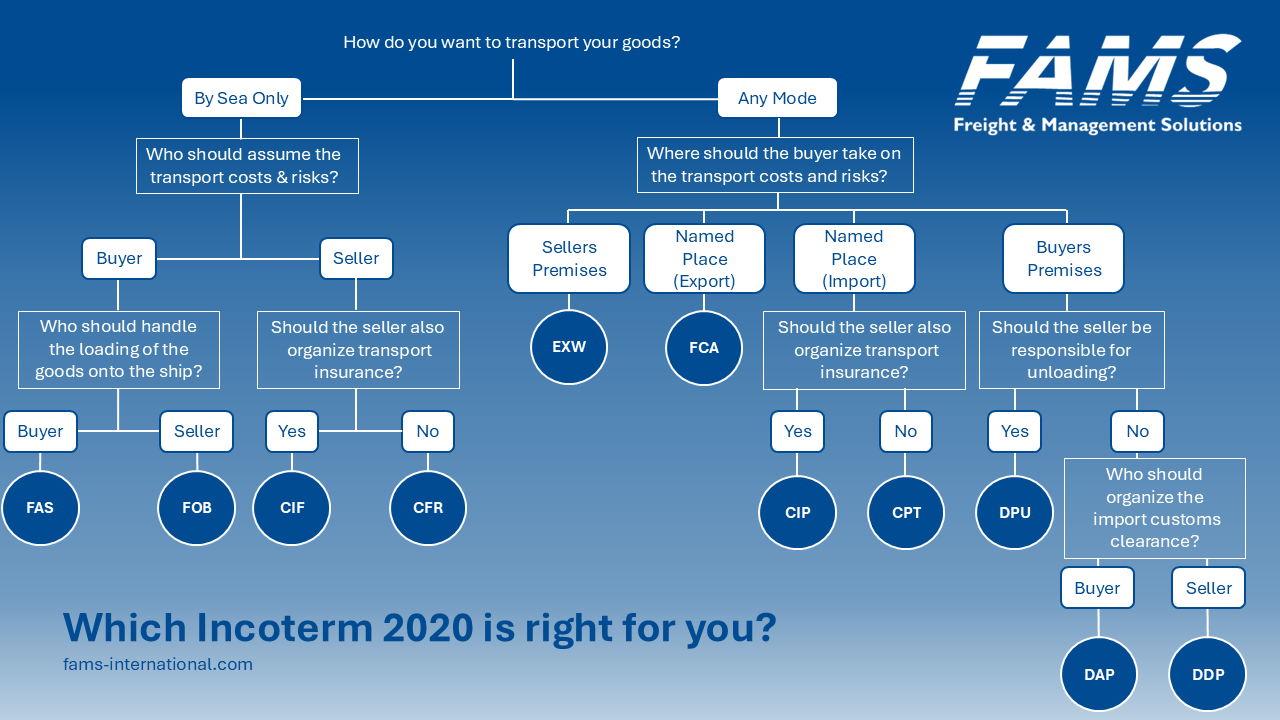
The Sea Transport Incoterms (FAS, FOB, CIF, CFR) are designed only for waterway transportation. These should only be used if your cargo is being transported on a barge or a ship during it’s international trip.
The General Incoterms (EXW, FCA, CIP, CPT, DPU, DAP, DDP) cover any mode of transport, from air to rail and even to sea transport itself.
It is the Seller’s obligation to provide the Bill of Lading or other maritime transport document upon delivery.
As a buyer, if you want to clearly show in your contract that your supplier is responsible for insuring your goods, use the relevant Incoterms: CIF or CIP, and specify directly in your contract which risks the insurance should cover.
In international trade, export customs duties are usually borne by the seller, while import duties are usually borne by the buyer. Clearing the goods at customs also means taking care of any permits and licences that are required for compliance.
When the buyer is to have responsibility of customs processes at both export and import, the EXW incoterm should be used.
When the seller is to have responsibility of customs processes at both export and import, the DDP incoterm should be used.
To make sure the correct Incoterm is applied, it must be clearly indicated in your contract of sales, using the following structure:
[Selected Incoterms®], [Named location], [in accordance with Incoterms® 2020]
e.g. CIF, Long Beach, Incoterms® 2020
An Incoterm is only valid once the contracting parties have determined a city location or a port. Indicate these places as accurately as possible.
The Correct Version
It is still possible to use the Incoterms® 2010, the Incoterms® 2000, and even earlier versions of the Incoterms®. Therefore, when specifying the terms of delivery, it is necessary to indicate which version of the Incoterms® should be used.
The new Incoterms 2020 rules were revised by the International Chamber of Commerce. It is always important to specify that you are using the 2020 edition.
FAMS has operated for many years across several countries in Southern Africa including Angola, Mauritius and Indian Ocean Islands and Zimbabwe.
Our staff draw on decades of international and regional logistics experience in managing supply chains, logistics and warehousing for leading global corporates and SME’s. The company has unrivalled operational and commercial logistics experience in many industry sectors. FAMS have a diverse global corporate customer base in mining, agriculture, life sciences, energy and chemical industries.
Start a conversation with the FAMS team today and find out how we can help your African business operate with market leading efficiency.
Developed by BigWebMedia